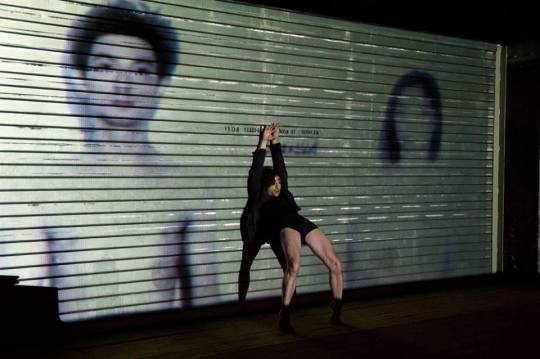
La performance est composée de deux écritures corporelles articulées présentant le corps du mime en jeu, développée dans les créations de la Compagnie Vahram Zaryan : cette performance balaye et articule le mime classique et le "Non-mime".
"Mater Replik" c'est l'histoire d’un personnage exilé, déplacé, bougé de terre. A cette première secousse succède une suite de répliques visibles sur son corps. Dans un lieu sans nom, dans l’atmosphère étrange d’une cérémonie, le personnage se débat pour vivre, transforme les objets du quotidien et lutte avec la terre natale et invisible qui s’insinue partout.
Durant la rencontre à l’issue de la représentation la Compagnie présentera l'écriture gestuelle et de la notion de "Non-mime". Cette notion est inventée par Vahram Zaryan et développée avec la complicité de F. Bracon, son dramaturge, afin de penser et créer un mime contemporain comme nouvelle discipline dans ce genre plus ancien.
Production : Compagnie Vahram Zaryan, Est' Nova Production, avec le soutien de l'Atelier du Plateau
La Compagnie Vahram Zaryan est née de la collaboration de plusieurs artistes s’associant pour faire des créations où dialoguent et se confrontent différents champs artistiques. Formée d’un artiste performer, d’un photographe, d’un vidéaste, d’un créateur son et d’un auteur, ce sont les premières créations qui leur ont données leur matière artistique commune: c’est un des artistes de la Compagnie, ces créations, qui deviennent le sujet de travail des autres membres. C’est son corps, sa voix, son image, transformés par les différentes pratiques artistiques qui constituent les parties d’une nouvelle création. C’est un sujet dont le démembrement imaginaire et la plantation de ses différentes parties dans plusieurs champs d’expression constituent le meilleur moyen de percevoir son unité. Ce sujet, où artiste-objet, peut à son tour devenir son propre sujet de création. A partir de l’artiste-objet « Vahram Zaryan », la Compagnie a crée plusieurs performances sur l’exil, l’identité puis le genre : des textes, des vidéos d’art, des photos, plusieurs performances de mime contemporain et spectacles. Il crée Confession, IL Y A, Mater Replik, La Tête en bas en 2014-15 (libre adaptation du roman de Noëlle Châtelet), OBLIQUE’ Cycle 1 I Attracteur étrange avec Ensemble Regards, composé à partir de poèmes originaux de Frédéric Parcheminier. En cours de création, Oblique Cycle 2 I ... Ces spectacles et les nombreuses performances ont été donnés dans des salle, des festivals et des galeries aux États-Unis, en Russie, en Europe de l’est, à Paris et en France. La Compagnie a à cœur de partager sa recherche sur le mime et l’écriture dramaturgique du mime contemporain avec le plus grand nombre. Dans cette dynamique elle crée de nombreux ateliers dans les collèges parisiens, avec la Ville de Paris dans le cadre de l’art pour grandir, et avec la Région de Saint Denis et l’association Citoyenneté Jeunesse entre autre.
La Compagnie Vahram Zarya et l'Ensemble Regards se sont réunis pour faire découvrir par la musique contemporaine, performance et le mime contemporain, une recherche sur le concept de l’oblique. Librement inspiré par des poèmes de Frédéric Parcheminier, le spectacle « Oblique cycle 1- Attracteur Etrange » – est une performance interprétée par un quatuor spécial : deux musiciens et deux performeurs. Dans Oblique cycle 1, l’accordéon est tour-à-tour le double du performeur et de l’acrobate aérienne, hybride avec l’électronique live, et plus intime avec des arrangements de chants venus d’Arménie, de Galice du Japon et de Pologne.
Musique: Vincent TROLLET, Conception et mise en scène : Vahram ZARYAN, Informatique musicale: Hiromi WATANABE,Vidéo: Auguste DIAZ et Vahram ZARYAN, Lumière: Cédric HENNERE, Conseil dramaturgique : Laurent MUHLEISEN, Collaborations artistiques : Karen HAKOBIAN
Avec: Pauline NADOULEK, Vahram ZARYAN (performer, mime contemporain) Jean-Etienne SOTTY (musicien, accordéoniste), Victor HUGUENIN (musicien électro-acousticien), Production et administration : Florent BRACON et Jana JASENKOVA
Production: Compagnie Vahram Zaryan et Ensemble Regards, Diffusion : Est’ Nova Production,Coproduction: Atelier du Plateau à Paris (Scène Nationale de Quartier).
OBLIQUE’ Cycle 1 est soutenu par la DRAC Ile-de-France, La Ville de Paris, Spedidam, Sacem, Institut Martin Luther. Avec l’aide d’Arcadi Île-de-France, dans le cadre des Plateaux solidaires.
French-Armenian
mime artist Vahram Zaryan holds a unique place in
today’s performance world.
A graduate
of Armenia’s National Conservatory in Yerevan and the École internationale de
Mime de Paris, he has performed on world stages throughout the United States,
Russia and Europe. He has where he studied with many legends across a range of
disciplines. To master the artistry of mime, he learned from the master, Marcel
Marceau, a French actor and mime most famous for his stage persona as “Bip the
Clown.” For dance, he studied with Yves Casati at the l’Opéra de Paris, and the
technique Etienne Decroux, he learned from Ivan Bacciochi.
Zaryan’s
experimental nature has led him to invent and champion the concept “No-mime”—an
attempt to push the boundaries of mime and make it relevant to the contemporary
stage. With his Compagnie Vahram Zaryan, he and a small group of
fellow artists continue to conceive of new productions, as well as give
workshops and master classes, along with his production company Est
Nova. It was my pleasure to sit down with him and to get to know this
wonderfully erudite and unique performer better.
***
Christopher
Atamian: Vahram,
you’ve led a rather peripatetic life and resided in several different countries.
What did your travels teach you and how did they influence your identity and
your art?
Vahram
Zaryan: Travel
has been an important means of self-discovery. Each trip that I’ve taken has
also been a journey in self-knowledge. It has represented exile, as well.
Travel and being in contact with different cultures has paradoxically brought
me both closer to my own self while distancing me from it, as well. I’ve always
felt 100 percent Armenian and 100 percent French simultaneously. Countries were
made in order to be explored, after all. You should never stop moving. And I
personally feel that I was born not once but several times, each time in a
different place. I was born a first time in Armenia in Shirakamut (formerly
Nalband) Village. I was born a second time buried under the rubble of an
earthquake whose reverberations I still feel down to my very core. And then I
was born a third time when I met my mentor and teacher Marcel Marceau. I
experienced yet another birth performing on the stage. I am born and I die each
time that I perform, with each story that I tell and through each one of the
characters that I create. I’ve often discussed this in my work, most notably in
“Mater Replik,” which I premiered in New York City at the Richmond Shepard
Theater.
C.A.: How did you train in order to
develop your particular contemporary version of mime and performance?
V.Z.: My training as a mime is informed by
all of the different forms of contemporary art: it is in dialogue with all of
the arts. I studied theater arts at the National Conservatory in Yerevan and
later with Marcel Marceau. I also studied classical and contemporary dance, as
well as music and traditional theater. Mime is an ancient and well-known art
form, yet it is rarely performed. Marcel Marceau is an iconic figure, his work
is unique.
C.A.: What led you to this particular
contemporary performing art form? I ask, because you have great respect for
your craft but you also insist on shaking up many of its existing norms.
V.Z.: Today my latest creations such
as Oblique Cycle 1 confirm what I have felt intuitively for
several years now, that is to say that a process has developed which involves
the disappearance of a formatted, purely social body destined to please
society’s gaze, in favor of a more organic and free body. This gives the modern
mime today access to a primitive, primal body.
C.A.: You are a proponent of “No-mime,” a
new and creative vision for gestural theater. Can you explain to us what this
involves?
V.Z.: I develop and create work with a team—along
with my dramaturg Florent Bracon—that exists at the crossroads of video, music,
and poetry. We are involved in rethinking the fundamentals of contemporary
mime: Our work is cross-disciplinary. Everything I experience influences my
work. I have brought together a group of artists who have purposefully moved
away from traditional pantomime. One of “No-mime”’s objectives is to do away
once and for all with the clichéd idea that mime is only about imitation. A
certain vision of art must be done away with in mime—the way it happened in
painting, for example. I am doing away with the superficial body and replacing
it with a body that resounds with organic interior beats/pulsations.
My
performances, and their dramaturgy, are never illustrative. When I interpret a
performance, my body undergoes a change that gives it access to these vital,
passionate, violent, torn pulsations, which establish a rhythm to our
relationship with the world. That body goes beyond thought: in a way, thought
only watches the body from a distance—the interior sense of touch. Seeing
always mean seeing from a distance and seeing the distance itself—the interior
sense of touch, which replaces vision, puts the body in contact with itself and
transcends the distance of thought.
I have great
respect for Marcel Marceau, but I constantly push myself to go beyond his work.
To me that is the greatest way to pay homage to him. He opened the way and
popularized the art of mime, and he did it poetically. But art has changed, and
poetry has as well, and in order to be relevant to the world today and to
dialogue with it, the art of mime must also reinvent itself.
C.A.: What is your next important
performance and what will be its major themes?
V.Z.:I presented “Mater Replik” in New
York, which deals with exile and the inner echoes/trauma that it produces,
followed by “With One’s Head Down,” based on a novel by Noelle Châtelet, which
deals a man who is born a hermaphrodite, another sort of violent shock. And
last year in collaboration with the contemporary composer Vincent Trollet
and Ensemble Regards I created “Oblique,” the first part in a
triptych. Oblique Cycle 1, subtitled “Strange Attractor” is
currently on tour, and my company is going to perform soon in Spain and
throughout Europe and Russia. I also created Oblique Cycle 2 which
will be presented in 2019. This piece will mix contemporary mime, music, video
and poetry, all world premiere/new works. Its major themes revolve around
identity and the body’s ambivalence: on stage forces seem to dictate to the
performer how to walk and move. These forces include morality, propriety,
aesthetics, the family, etc. But interestingly enough the road that our
movements take is never the one we expected. Even under constraint the body
always deviates from its assigned trajectory. I would say that compared to
morality and aesthetics for example–which are external demands, “it never
works”, “it’s never perfect.” Well I think it’s because the body screams
through these minute deviations that I make visible throughout the performance.
The body cries out that it wants to be free, it never corresponds to an ideal.
C.A.: What would you like the reader to
know about you, your art, or your performances?
V.Z.: I want to make readers and audiences
alike understand that mime is a necessary art in a noisy and talkative world.
The mime’s silence doesn’t say “nothing”: it is instead a contrast with the
endless noise in a world that doesn’t know what to say. It’s the mime’s silence
that makes speech important again.
C.A.: Finally, is there an Armenian
context for your art?
V.Z.: My entire story tells the story of
my country, my land is always a part of me. the more lands one has, the more
food one has which feeds one’s development. And one learns what it means to go
away, to leave, and to return. It’s a passionate love story: by that I mean
“corporeal, without thought, real and immediate.” “Mater Replik” tells this
story in fact, that your homeland follows you wherever you go and how it can
give you strong roots, or on the other hand weight you down. At the same time
the traditional arts. which are closer to my origins, paradoxically bring me
closer to my contemporary creations. There is something organic in them. Also
in my works, the contemporary is always accompanied by references to tradition
as well. These roots are like the roots of a tree that are deeply ingrained,
except they point towards the sky…
Librement inspiré de poèmes de Frédéric PARCHEMINIER
Oblique Cycle 1 est une œuvre essentiellement performative et sonore.
A l’origine du projet,
Vahram Zaryan, chorégraphe et performer, a proposé à un groupe
d’artistes le thème de l’ « Oblique ». Frédéric Parcheminier a alors
écrit les textes, Vincent Trollet une musique originale pour un
accordéon à quarts de ton avec dispositif électroacoustique. Vahram
Zaryan en collaboration avec le compositeur Vincent Trollet ont mis en
scène un quatuor composé de deux musiciens, d’un performer et un
acrobate aérien.
La performance Oblique Cycle 1
nous invite à parcourir un chemin intérieur : l’idée fixe, le trouble
et la tentation. Sur la scène, leurs inclinations et déséquilibres
provoquent une cohabitation inattendue : attracteur étrange, oblique
sensible, aller, le bal des ondes. Ainsi, le corps, le son et les mots,
s’associent et se rencontrent pour faire naître un dialogue entre les
arts.
La Compagnie Vahram Zaryan crée des spectacles de mime
contemporain et des performances en France et à l’étranger. L’Ensemble
Regards est un ensemble de musique contemporaine. Oblique Cycle 1,
soutenu par Est Nova Production,
est le fruit du rapprochement de ces deux structures avec une
préoccupation commune, la recherche et la création interdisciplinaire.
Vahram Zaryan <Non-mime> is a contemporarymime movement,
process of research occuring in the creations of <Vahram Zaryan>
theatrical group, <Vahram Zaryan Company>. Transdisciplinary mime performances are created with the artists belonging to different mime
schools denying the traditional pantomime. The performances include various
types of art (theatre, video, reading, applied art). The loss of body becomes
apparent in the performance. In this case, does the body dynamique disappear? Does
the presence of body end as an essential element in the performance? If it
is so, is our perseption on mime lost? Nowadays contemporary pantomime is
no longer the one we used to know. The existence
of <non-pantomime> is resumed in the perseption of the main essence of pantomime,
its source and evolvement, in rising questions upon them. Such
evolvements have occurred in other fields, as well, radically going further
form the traditional ones.
Vahram Zaryan
‘Body is not the
only tool’
No longer concentrating on only the aestetique and
visual material of the body, it is attemped to get rid of it, working on the
meaning and depth, in which case the very aestetique and visual perception to
body is back in another form. This situation is persived more profoundly and vividly,
as it includes not only the questions of time and essence unpersivable with the naked eye. Nevertheless, body does not oppose the soul. Body is
not considered as a tool to serve the soul. It is no longer a fortress of the
primary aim to connect it to the environment. Nowadays a contemporary artist should no longer be
persived as a lonely <wall> opposing the world with its closed and nice
performance.
<Non-mime>
is an existence in space
Pantomime performance is no longer a platform to show
dynamique actions, where the impressive body images and dynamiques are over-valuated. Firstly, mime is a means to create and display
the emotional disagreements between the artist and the society. <Non-mime> movement is no longer expected,
and allows to persive the meaningful action born in a certain area chosen by
the artist, let it be stage, square or street. Pantomime is an evolving art necessary in our noisy
and <talkative> lifestyle.
Installation : Anthony Baillard
Performance : Vahram Zaryan
Anthony Baillard propose une danse d'ombres et de lumières avec un performeur prisonnier derrière une surface translucide, dans une nouvelle vision de l’allégorie de la caverne de Platon.
L’œuvre est produite par Out of Pluto, une société pluridisciplinaire qui rapproche les mondes de l’art, de la science et de la technologie, et interprétée par le mime et chorégraphe Vahram Zaryan.
Original Mix inspiré par La Tête en bas| Performance | Mime contemporain Librement inspiré du roman éponyme de Noëlle Châtelet « La tête en bas » publié aux Editions du Seuil et Points Un spectacle de Vahram Zaryan, artiste de performance Thérémine : Armen Ra | Composition d’Amê La voix : Artavazd Youzbashyan
La salle Jouvet, CNSAD Paris, photos: Diego Bresan
Théâtre est une fresque polyphonique et polyglotte à 50 voix, une
traversée chorale du temps et de l’espace mêlant le chant et la parole,
la partition et l’improvisation, un voyage de sons et de sens, un
présent partagé et morcelé d’où jaillissent des fragments, des
étincelles, des univers, des paysages croisés, emboités, superposés les
uns aux autres… Le public - vers qui tout converge et se dissout - est
au centre du dispositif, plongé entièrement dans la matière sonore
brassée et transformée dans une obscurité polychrome et plurielle. Le
silence se fait matière et l’écoute devient moteur du jeu. Le décor, les
costumes et l’éclairage sont les voix résonnant dans les corps et se
propageant dans l’espace qui s’ouvre et se diffracte en d’autres
espaces…
La salle Jouvet, CNSAD Paris, photos: Diego Bresan
Spectacle en allemand, anglais,
arabe, arménien, basque, bassa, batak, créole de Guadeloupe et d'Haïti, espagnol,
filipino, flamand, fongbé, français, grec ancien et moderne, hébreu,
hindi, indonésien, islandais, italien, japonais, Kabyle, latin, lingala,
mandarin, norvégien, persan, portugais, roumain, russe, sanscrit,
tamoul, ukrainien, yoruba…
Conception, mise en scène, direction musicale et travail vocal
— Marcus Borja
Collaboration dramaturgique
— Tristan Rothhut
Assistantes à la mise en scène
— Alexandra Cohen et Raluca Vallois
Design sonore
— Lucas Lelièvre
Photographies
— Diego Bresani et Ye Tian
Régie
— Gabriele Smiriglia
avec:
Jérôme Aubert, Astrid Bayiha, Roch Amedet Banzouzi,
Sonia Belskaya, Marcus Borja, Augustin Bouchacourt,
Lucie Brandsma, Sophie Canet, Antoine Cordier,
Etienne Cottereau, Belén Cubilla, Mahshid Dastgheib,
Alice Delagrave, Márcia Duarte, Simon Dusigne,
Rachelle Flores, Michele Frontil, François Gardeil,
Lucas Gonzalez, Louise Guillaume, Lola Gutierrez,
Jean Hostache, Hypo, Magdalena Ioannidi,
Miléna Kartowski-Aïach, Matilda Kime, Cyrille Laik,
Malek Lamraoui, Francis Lavainne, Feng Liu,
Hounhouéno Joël Lokossou, Yuanye Lu, Esther Marty Kouyaté,
Laurence Masliah, Jean-Max Mayer, Romane Meutelet,
Tatiana Mironov, Makeda Monnet, Rolando Octavio,
Cordis Paldano, Wilda Philippe, Andrea Romano,
Tristan Rothhut, Théo Salemkour, Charles Segard-Noirclère,
Peik Siren, Isabelle Toros, Raluca Vallois,
Gabriel Washer, Sophie Zafari, Vahram Zaryan
Photo: Ye Tian
Photo: Laurent Marion
Le 17 février à 15h et 19h
et le 18 février à 19h
dans le cadre du FESTIVAL JT6, organisé par le Jeune Théâtre National
13 rue des Lions Saint-Paul, 75004
Métro Saint-Paul (ligne 1) ou Sully-Morland (ligne 7)
Entrée libre dans la limite des places disponibles
Ouverture des réservations le mardi 26 janvier
Réservation indispensable au 01 48 04 86 40
Site internet : www.jeune-theatre-national.com
Les 3 et 4 mars à 15h et à 20h
Conservatoire National Supérieur d'Art Dramatique
Salle Louis Jouvet
2 bis, rue du Conservatoire, 75009
Métro Grands Boulevards (lignes 8 et 9)
Ouverture des réservations le lundi premier février
Réservation indispensable au 01 53 24 90 16
Site internet : www.cnsad.fr
While French parliamentarians are going to discuss the changes in the law on intersex status, the hidden parts of a real life of a hermaphrodite is being staged by Vahram Zaryan Company in Paris. Scandalous experimental performance: music and movement theater, mime and countertenor, based on Noëlle Châtelet well known novel ''La Tete en Bas''. Don't miss it! September 24, 25,26 27 and October 2 and 3. For more dates and detailsseeVahram Zaryan Company
Librement inspiré du roman éponyme de Noëlle Châtelet "La tête en bas",
Vahram Zaryan et sa compagnie s’attellent à un sujet controversé :
L’hermaphrodisme.
" J’ai quinze ans et je suis un monstre. […] Rien ne va avec rien. Un
morceau de femme par-ci, un bout d’homme par- là, un bazar d’erreurs,
inexactitudes. A deux dans un même corps." Noëlle Châtelet
Le spectacle commence, le coup de théâtre a déjà eu lieu : c’est le
choix du sexe féminin par les parents du personnage, le non-choix de
celui qui subit. Quelque chose est en sus- pend dans l’intime du héros
où se fait la genèse de l’identité, de la liberté, l’indéterminé à venir
de l’enfance, où l’élan se prend pour sauter de l’absence de genre au
genre : cet élan est coupé par le désir des parents qui s’impose. Il a
comme chemin de fuite le corps et son geste comme art, le geste qui
transforme les mots perdus en parole.
Vahram Zaryan (se) met en scène l’histoire d’une vie, d’un parcours d'un
être à la fois homme et femme. Une recherche centrée sur le vertige des
identités et la confusion des genres qui interroge l’humain dans son
intimité la plus profonde. L'écriture gestuelle de Vahram Zaryan et la
voix du contre-ténor : Amé Karen Hakobian se mêlent dans
une dramaturgie plurielle qui allie la vidéo d'art à des sonorités
étranges d'instruments méconnus. La compagnie porte un regard sensible,
engagé et radical sur le texte de Noëlle Châtelet.
La performance "La tête en bas" est librement inspiré du roman de Noëlle Châtelet
Mise en scène: Vahram Zaryan
Dramaturgie: F.Bracon
Scénographie: Vahram Zaryan
Collaborateur artistique : Laurent Muhleisen
Musique: Amé Karen Hakobian, Suren Shahi-Djanyan
Lumières: Loic Samson
Vidéos: Auguste Diaz, Vahram Zaryan
Régie Son : Pietro Loconte
Thérémine: Armen Ra
Avec: Vahram Zaryan, Amé Karen Hakobian
Dans les vidéos : Pauline Nadoulek, Gaëlle Nguyen, Artavazd Yusbashyan
Audio Mixage: Simon Gendrot, Laurent Marion, Clément Vincent, Adrien Colle
" J’ai quinze ans et je suis un monstre. […] Rien ne va avec rien. Un
morceau de femme par-ci, un bout d’homme par- là, un bazar d’erreurs,
inexactitudes. A deux dans un même corps."
(extrait de "La tête en bas"
de Noëlle Châtelet publié aux éditions du Seuil.
Le spectacle met en scène l’histoire d’une vie, l’histoire qui traite
un sujet actuel et controversé de l’identité sexuelle d’une personne
hermaphrodite.
Représentations se dérouleront à L’Atelier du Plateau, 5 Rue du
Plateau, 75019 Paris, du 24 au 27 septembre 2014 a 20h. Elles seront
suivies de rencontres-débats en présence de Noëlle Châtelet.
Après l’exposition qui lui était consacrée à
“La Nouvelle Vague” au Palais de Tokyo, Nina Childress présente “Rideau
vert”, à la Galerie Bernard Jordan le 22 février 2014. A cette occasion le mime contemporain et
performeur Vahram Zaryan réalisera de 16h à 19h une performance,
inspirée de Mime Corporel Dramatique d’Etienne Decroux, devant cette
œuvre qualifiée “d’intervention in situ théâtrale et troublante”. Ce
Rideau vert de 3 x 4m convoque une présence fantomatique.
Alors que Nina Childress explore dans ses
dernières pièces le travail du Mime Etienne Decroux, dévoilant les
artistes dans toute leur vulnérabilité, le Mime et performeur Vahram
Zaryan, comme un prolongement du “Rideau vert”, figure son mouvement
immobile et habite la scène vide ouverte sur le spectacle troublant de
ce rideau, comme l’ultime témoin du spectaculaire.
Si selon Etienne Decroux “L’émotion guide
le mouvement, la pensée engendre l’immobilité”, c’est au mélange ambigu
que nous convoque “Rideau vert” de Nina Childress et la performance de
Vahram Zaryan : celui d’un mouvement immobile et d’une incarnation
sensible de la pensée.
A travers leurs spectacles, Vahram Zaryan et sa compagnie explorent l’exil et l’identité avec le mime contemporain : Confession 1 et Confession 2, IL Y A et aujourd’hui Mater Replik.
Sur scène, un être témoigne de son rapport complexe avec la terre :
de la terre maternelle à la terre promise. Seul dans cet espace, avec
une terre qui s’insinue partout, que découvre-t-il de son corps et de
ses propres émotions ? Au prise avec cette invasion, il se débat et
lutte en réinventant, jusqu’à la folie, les gestes du quotidien.« L’exil ne me semble pas être seulement l’état des immigrés ou
des réfugiés. Si, comme je le crois, le corps de l’exil est en
déséquilibre, alors tous les corps nous montrent que nous sommes exilés. » Vahram Zaryan


 La Compagnie Vahram Zaryan est née de la collaboration de plusieurs artistes s’associant pour faire des créations où dialoguent et se confrontent différents champs artistiques. Formée d’un artiste performer, d’un photographe, d’un vidéaste, d’un créateur son et d’un auteur, ce sont les premières créations qui leur ont données leur matière artistique commune: c’est un des artistes de la Compagnie, ces créations, qui deviennent le sujet de travail des autres membres. C’est son corps, sa voix, son image, transformés par les différentes pratiques artistiques qui constituent les parties d’une nouvelle création. C’est un sujet dont le démembrement imaginaire et la plantation de ses différentes parties dans plusieurs champs d’expression constituent le meilleur moyen de percevoir son unité. Ce sujet, où artiste-objet, peut à son tour devenir son propre sujet de création. A partir de l’artiste-objet « Vahram Zaryan », la Compagnie a crée plusieurs performances sur l’exil, l’identité puis le genre : des textes, des vidéos d’art, des photos, plusieurs performances de mime contemporain et spectacles. Il crée Confession, IL Y A, Mater Replik, La Tête en bas en 2014-15 (libre adaptation du roman de Noëlle Châtelet), OBLIQUE’ Cycle 1 I Attracteur étrange avec Ensemble Regards, composé à partir de poèmes originaux de Frédéric Parcheminier. En cours de création, Oblique Cycle 2 I ... Ces spectacles et les nombreuses performances ont été donnés dans des salle, des festivals et des galeries aux États-Unis, en Russie, en Europe de l’est, à Paris et en France. La Compagnie a à cœur de partager sa recherche sur le mime et l’écriture dramaturgique du mime contemporain avec le plus grand nombre. Dans cette dynamique elle crée de nombreux ateliers dans les collèges parisiens, avec la Ville de Paris dans le cadre de l’art pour grandir, et avec la Région de Saint Denis et l’association Citoyenneté Jeunesse entre autre.


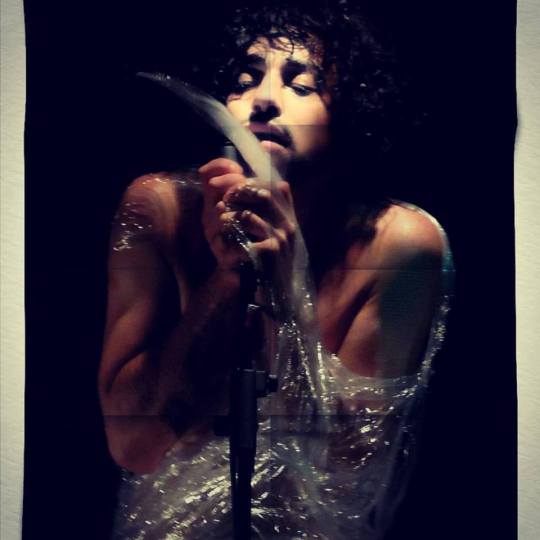 Vahram Zaryan